From vision to value: lessons from building a customer strategy and CX function
Diana Brink-Gourlay
Vice President, Customer | Aviva Canada Inc.
Jun 16, 2026
Customer experience Thought Leadership

Over the last several years, “customer-first” has become a highly used phrase in business. Everyone claims it, few operationalize it, and even fewer sustain it consistently and long-term. It is often not a failure of intent but a structural challenge.
The reality many CX leaders inherit:
- Some organizations have a centralized function responsible for customer strategy and interactions. But many are decentralized, where each business unit manages their customer experience.
- Direct customer contact may be limited, episodic or concentrated on key moments in the customer journey.
- Product, marketing and UX sit in separate functions with varying levels of collaboration.
- Past ‘customer initiatives’ have perhaps failed, making future executive and employee buy-in a challenge.
Case study: Lessons and recommendations
After spending 18 months developing an enterprise customer strategy and function, several lessons emerged.
Lesson #1: Mission-first
Start with strategy, not execution. Do not over-engineer the execution plan until you are sure the leadership team is aligned on the destination.
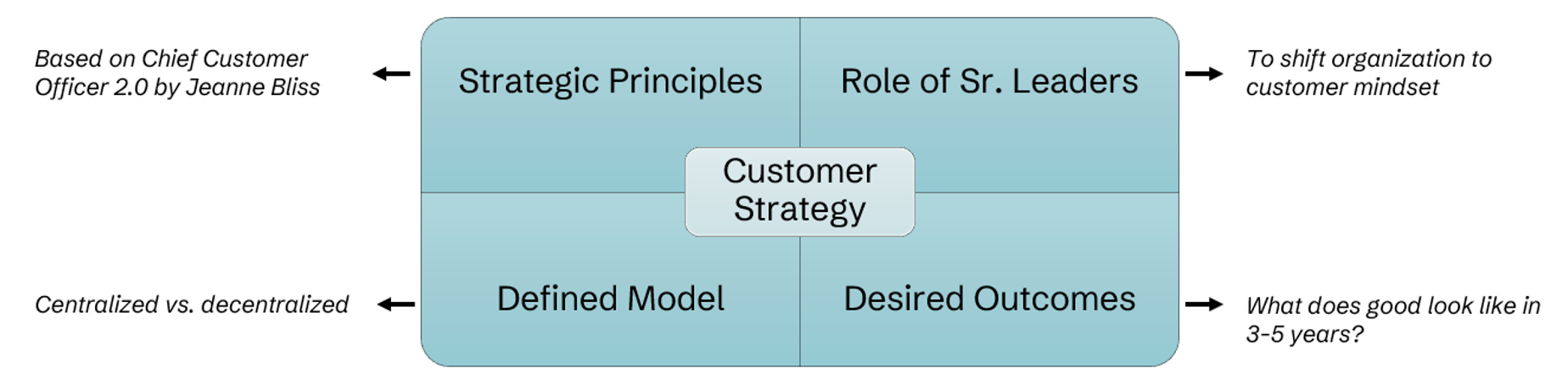
Focus on defining a clear customer strategy, not a detailed roadmap. The strategy should align with the enterprise’s long-term business vision and explicitly answer:
- What does “good” look like in three to five years?
- What role do senior leaders play in enabling that future?
- Where should decision rights live in a decentralized model?
- What outcomes actually matter to customers—and the business?
This approach leverages Jeanne Bliss’s five customer leadership competencies, which emphasize alignment, accountability, and treating customers as enterprise assets – something to be valued by the entire organization – rather than functional outputs.
Lesson #2: Mindset is key
Often, progress depends less on tools, data or funding, and more on consistently reinforcing a customer-led mindset.
Change simply doesn’t stick without leaders consistently:
- Asking customer-led questions,
- Reviewing CX data alongside financials, and
- Modeling trade-off decisions through the customer lens.
That’s why, for the organization, early efforts prioritized senior leader engagement over broad, tactical rollouts.
Lesson #3: Measure to drive credibility
Intentionally position CX measurement as distinct from operational and financial metrics—not because those don’t matter, but because they answer different questions.
A new dedicated CX scorecard enables leaders to:
- See trends over time, not one-off scores.
- Discuss customer impact with evidence.
- Build accountability without blame.
This measurement approach also ties back to lessons one and two: measuring progress toward what ‘good’ looks like and using the scorecard as a tool to shift mindset. Measurement isn’t framed just as “proof of CX value,” but also as a management tool.
Lesson #4: Momentum drives success
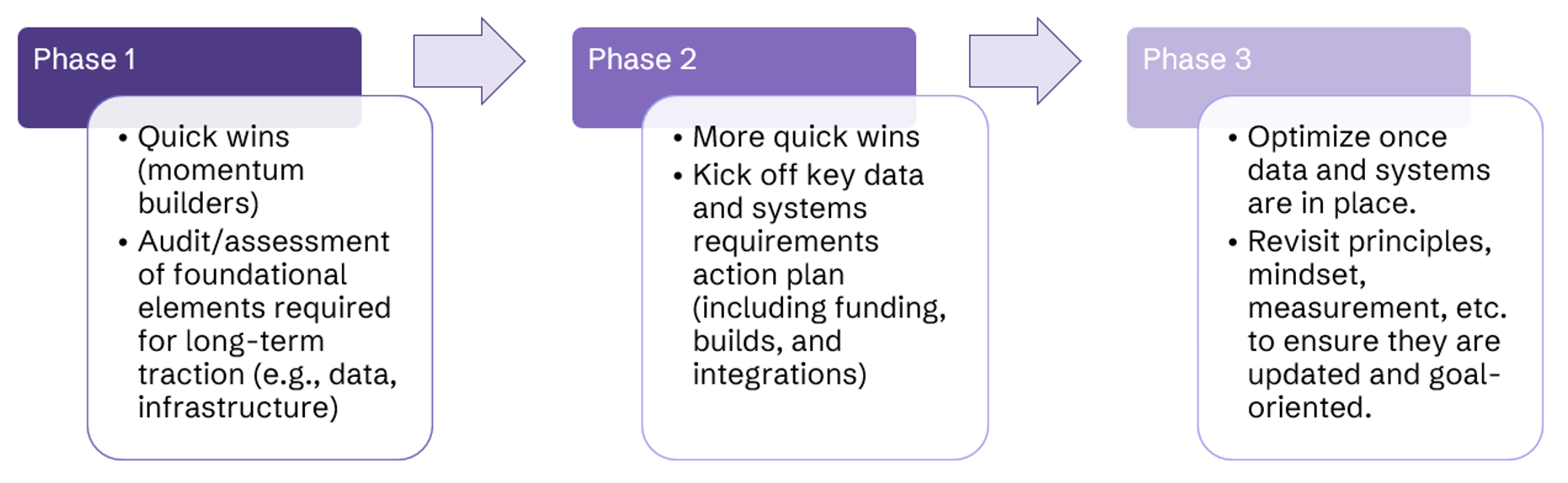
CX transformations can often lose energy, especially during the initiatives that can take a long time to show results. To help sustain engagement and progress, consider embedding regular momentum builders into the phased rollout plan, such as:
- Quick, visible improvements.
- Transparent updates on progress and learnings.
- Tangible examples of customer-first thinking improving decisions.
Regular updates to key internal teams are a powerful lever to gain further momentum and buy-in, while simultaneously working through long-term data, infrastructure and technology needs. Below are some notable results the organization has seen so far:
- Over 200 customer communications improved in six months.
- CX principles became visible artifacts—not abstract ideas.
- Teams saw customer thinking applied at scale.
Lesson #5: Model for engagement
There is often a belief that centralized customer ownership is essential to success. The trouble is that this often means the customer mindset is focused in one area rather than permeating the whole organization. So, instead of centralizing all customer decision-making, the customer team can operate as:
- Enterprise subject matter experts.
- Journey-level experience leaders.
- A support model embedded into key decisions.
Emphasize a model of enablement over ownership. The business still owns outcomes. The customer function owns consumer insights, customer needs, and long-term CX business objectives – driving a consistent customer experience across the whole brand.
Closing thoughts
After 18 months of planning and execution, the journey is well underway, and the organization is not stopping there. It is a multi‑year transformation, and employees are continuing to learn, evolve, and refine the approach every step of the way to deliver the best possible customer experience.
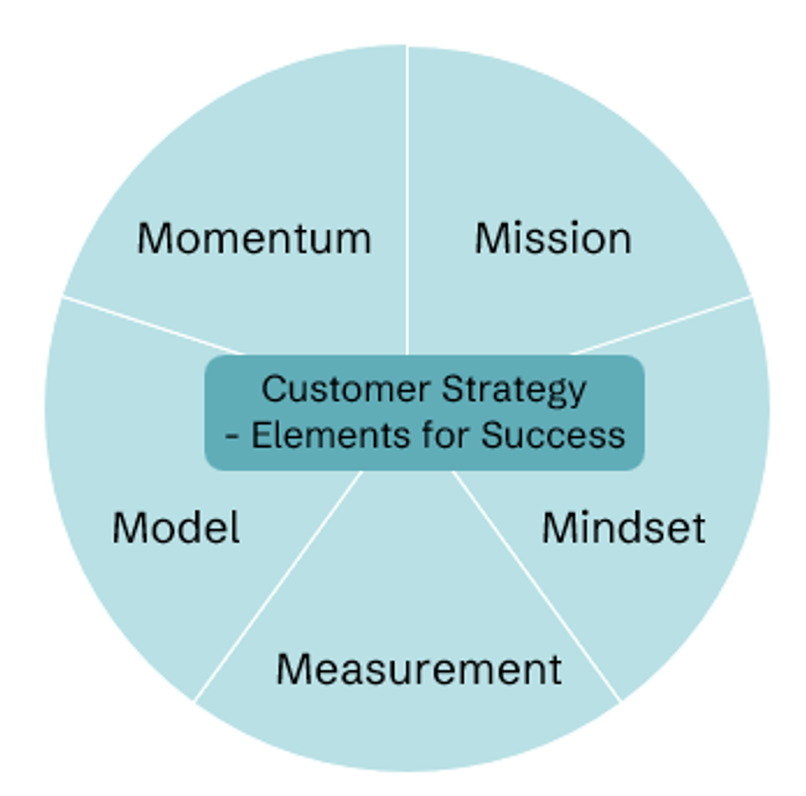
Through the work done so far, several key insights emerged that boil down to “the 5 M’s”:
- Mission: get alignment on the destination before diving into execution.
- Mindset: as leadership continues to champion a customer-first approach, CX becomes increasingly integrated into everything you do.
- Measurement: what gets reviewed gets managed. Credible measurement creates accountability and trust.
- Momentum: small wins sustain energy while harder, structural work continues.
- Model: centralized or decentralized customer ownership – either model can work if set up effectively.
Sources:
- Jeanne Bliss, Chief Customer Officer 2.0, published 2015
Author:
Diana Brink-Gourlay, VP, Customer, Aviva Canada Inc.

LATEST PERSPECTIVES
|VIEW ALL